Beach Town in a Forest

Beach Town in a Forest
Beach Town in a Forest, Pine Knoll Shores located in Carteret County on North Carolina's Crysal Coast. Photo compliments of Bill Flexman and Dave Prutzman

Saturday, June 28, 2025

John Allan Croskeys Royall: Isle of Pines REVISITED


John Allan Croskeys Royall at Royallmere, East Boothbay, ME
The original article about John Allan Croskeys Royall was published December 4, 2015, by founding members of the PKS History Committee, Walt Zaenker and Phyllis Makuck. They knew that a man named John A. Royall had sold Alice Hoffman the land that became Pine Knoll Shores and wanted to learn more about him. With his last name being common in the area and both his last and middle names having spelling variations, their search to find the correct John Royall was difficult. Nonetheless, based on their research, they wrote the article, believing they had found the correct Royall, but they were not completely sure. Seven years later it was confirmed! In 2022, Patricia Royall of Maine discoverd the Blog article, reached out to the PKS History Committee and confirmed that they indeed had found the correct man, her great-grandfather, John Allan Croskeys Royall. The story that follows is the original story posted in 2015, corrected and expanded to include some of what we've learned so far, gathered from Royall family records, personal letters, and research down the "rabbit hole" conducted by PKS historian Susan Phillips in collaboration with his great-granddaughter, Patricia Royall. Stay tuned for additional articles from Patricia's treasure trove and as more discoveries are made in "the rabbit hole." This article is the overview. Additional articles will follow with the spin-off stories in more detail. Stay tuned!

Who Was He?

Family Roots: John Allan Croskeys Royall was both a Southerner and a New Englander. He was born November 3, 1860, on Greenwood Plantation near Thomasville, in Glynn County, Georgia, and died March 13, 1959, in Tryon, NC. His father was John Bailey Royall of James Island, SC and his mother, Sarah Ann Robinson, of Camden County, GA. They had three children, Lewis Robinson (1859-1943), John Allan Croskeys (1860-1959) and Mary Ann "Minnie" (1862-1882). John's father died in the Civil War in 1862 when John was only two, leaving his mother to raise their three young children. 

John's Southern roots trace back to New England and Antigua. He was a descendant of Isaac Royall, Sr. (1672-1739) of Maine and his son, Isaac Royall, Jr. (1718-1791) of Medford, Massachusetts, both merchant mariners in Antigua and whose legacies endowed the establishment of Harvard Law School.

In 1891, John married Marilla Kingman in Philadelphia. She passed away from illness after only 8 years of marriage. Then on June 7, 1899, John married Agatha Caroline Freeman (left), an artist and graduate of the nurse training program at New York's Bellevue Hospital.[i] For their wedding trip, they boarded the SS Portia, a 220-foot steamship carrying 70 passengers and a crew of 34, and left New York City on July 8, 1899, for Nova Scotia. Not far from Halifax, the SS Portia wrecked on Big Fish Shoal. Fortunately, John, Agatha, the crew and passengers were rescued and survived except for one 12-yr old boy.[ii] 

John and Agatha returned to Massachusetts and made their home in Medford where they had four children, pictured left to right:  
John, Jr. (1900), Virginia Portia (1901), William Freeman (1904) and Robert Legrand (1906). 

Career:  John was self-educated and a successful businessman and entrepreneur. After the Civil War and the death of his father, his mother moved the family to Savannah, GA, where young John worked as a store clerk to help support the family. He later left home to take a job with a fruit shipping company in Florida and then moved to Boston and worked his way up from a mail clerk in the New England Oil Company of Boston, the largest independent dealer in the area, to become its managing Executive in the 1890s. Royall led the other independent dealers in fierce competitive battles against Standard Oil, supporting the independent dealers with ways to keep prices low for consumers and not to be driven out of business by Standard Oil.  

Royallmere on Ocean Harbor, East Boothbay, Maine
Around the turn of the century, Royall began investing his wealth in real estate. In 1903, as he was nearing retirement, he purchased a large tract of coastal property in East Boothbay, Maine, to build a summer home and create a compound for his family and future generations to enjoy. He designed and built a sprawling home on a high rocky ledge overlooking the Atlantic Ocean and named it Royallmere. The house had wide porches, his signature white columns (perhaps reminiscient of his early life in Georgia) 
and panoramic views on three sides.

A life-long yachtsman, Royall designed and owned numerous small craft, sailboats and steam yachts. In July 1903, he launched Virginia, a two-masted, 53' schooner yacht he designed and named after his daughter. It was built by Rice Brothers in East Boothbay, Maine, and sold to Daniel H. Grandin in 1918 for use on Lake Chautauqua in New York. 

   Virginia, a two-masted schooner yacht  
     

When Did John A. C. Royall Come to Bogue Banks?

We are not sure exactly when he first came here, but some clues tell us it was during the early 1900s.  We assume he was sailing south onVirginia, perhaps just exploring the coast in search of a warmer winter residence, a health retreat or hunting lodge or pursuing his interest in southern fisheries conservation. Whatever the reason, Royall found his way to Beaufort, NC, and discovered that undeveloped land could be purchased on the nearby barrier island of Bogue Banks. 

Between 1910-1912, we know for certain Royall purchased a number of land parcels from different owners, including the families of Taylor, Midyette, Lewis, Garner, Smith, Colburn and Styron as well as from the Eastern Carolina Land & Lumber Co. Eventually, he acquired three-fourths of Bogue Banks, stretching from Hoop Hole Creek in the east to Bogue Inlet at the west end of the island, approximately 8,000 acres. He called the land Isle of Pines.

A 1913 article written by Martin V.B. Ives[iii] after visiting the Royalls on Bogue Banks confirms some of what we know:


Royall chose an ideal location on the more protected, north-facing sound side of the island for his winter home in the area known today as Pine Knoll Shores. He designed and built a cedar shake bungalow with two open back porches, one with a pergola supported by his signature white columns and one with an outdoor brick fireplace, all nestled among yucca plants, tall pines, and fragrant yellow jasmine hanging from the trees. He named it Pine Court. He was respectful of the land and always committed to leaving a small footprint.
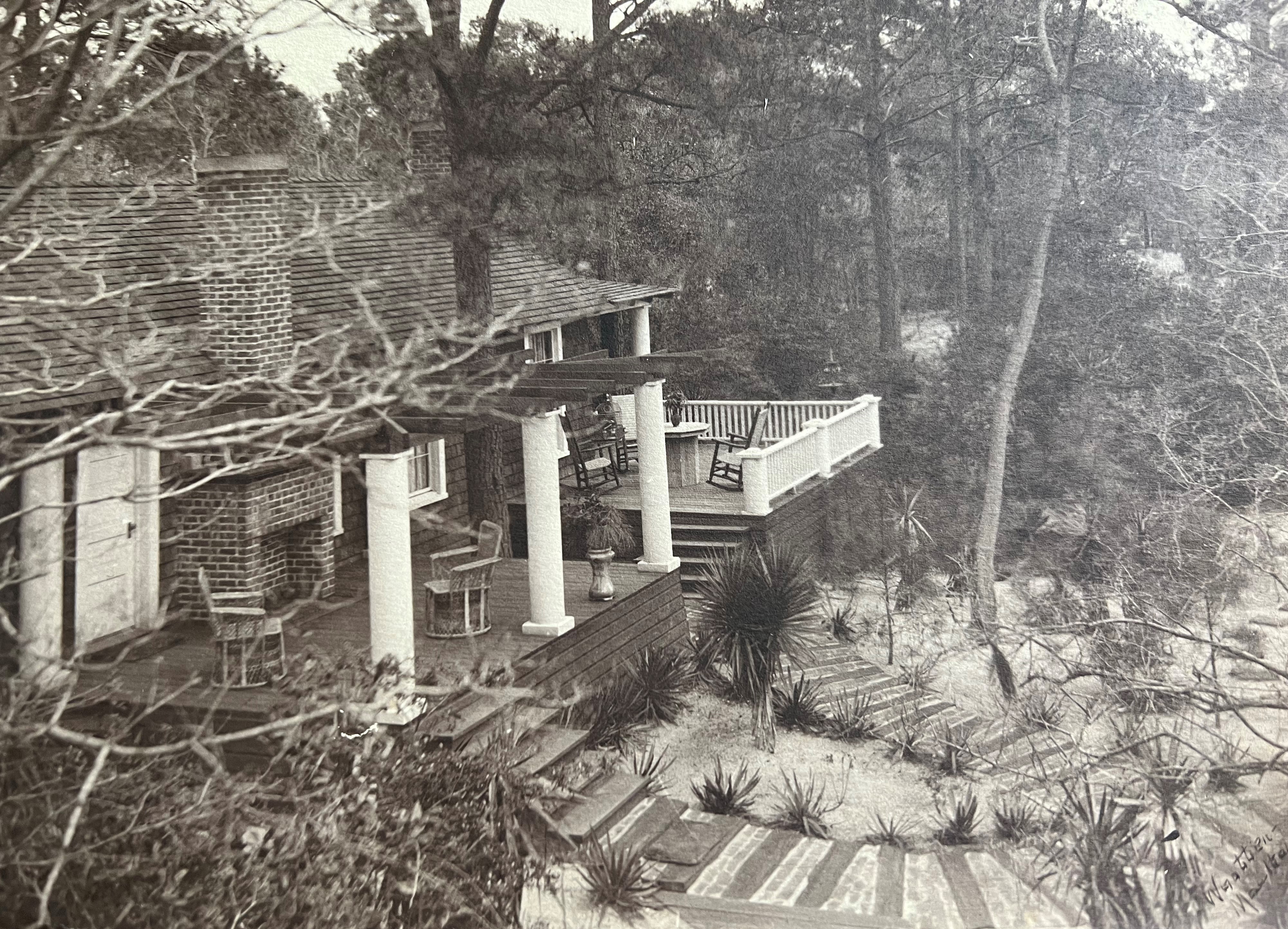


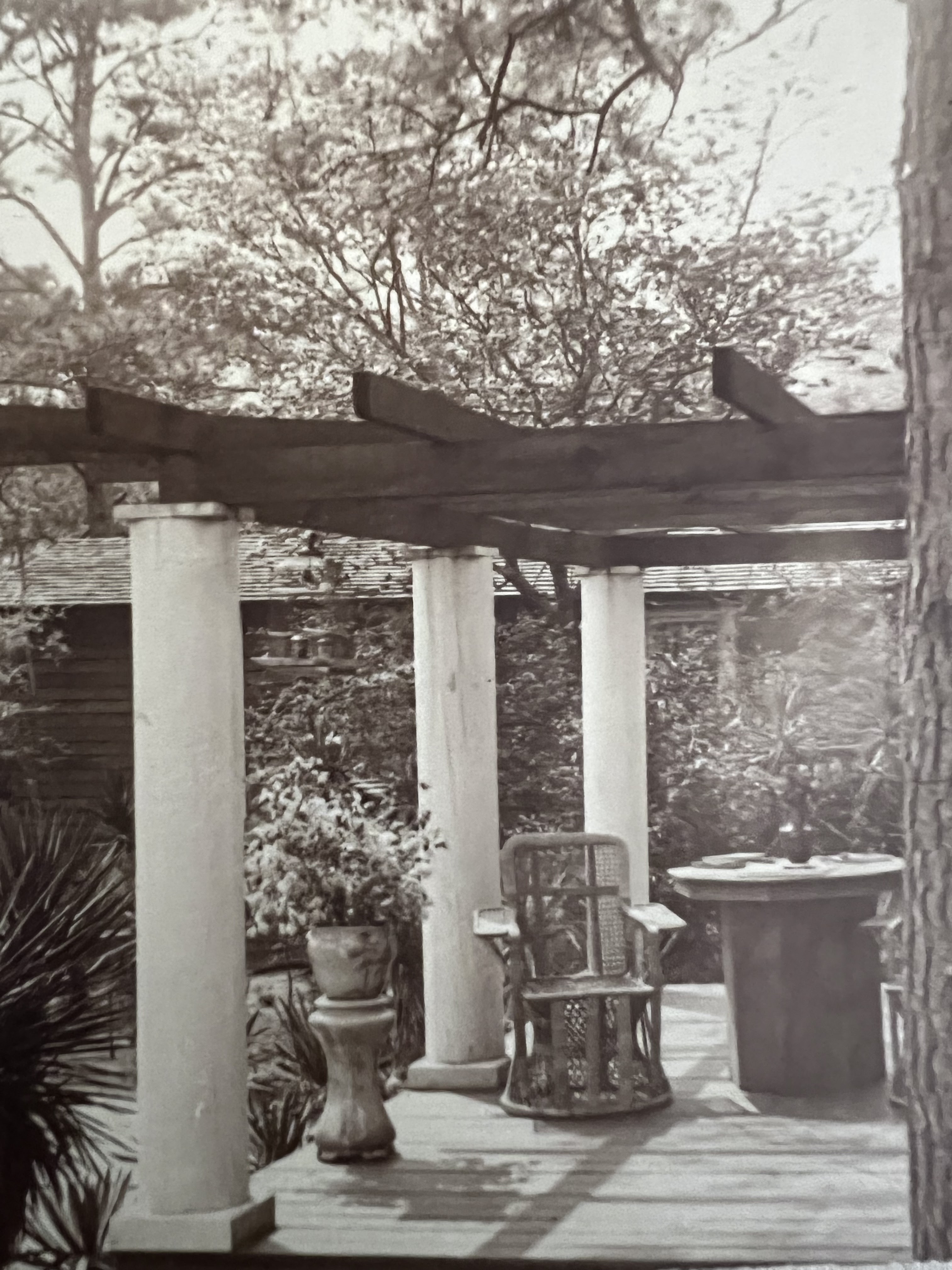


His homes gave way to the natural  landscape and when completed, looked as though they belonged there. 
Royall also built a small cottage neaby for a Beaufort physician friend and a long dock extending out to deeper water to accommodate his sailing yacht and motor launch. As there were no roads or access to the area by land, his building materials were brought by boat or scavanged from the beach when timbers washed ashore from shipwrecks, as his son, Robert, tells in a March 30, 1980, Carteret News-Times article. [iv]
Although less than half a mile across the island to the ocean on the south side, it was difficult to reach because of the thick vegetation of the maritime forest. Ives and later, Alice Hoffman, describe wide, winding footpaths that Royall carved out for easier access to the ocean. He later designed and built a tea house atop a high dune so that his family and friends could enjoy the panoramic ocean views and breezes. We believe it was located in the area of today's Memorial Park. 

Within Royall's 8,000 acres, there were scattered parcels held by others. The largest was 82 acres bought by Oscar Kissam in 1908. Mr. Kissam subdivided his property and sold lots to neighbors from his hometown of Huntington, New York. A few of the lot owners built cabins as winter retreats. This development was called Aibonita (See Aibonita Blog article for details.) The Royalls and the Abonita families were neighbors and in today's terms, their homesteads were west of the Oakleaf Drive bridge. It was originally thought that the 1912 Aibonita photograph below might have included John and Agatha Royall, but none of their photos in the Royall family albums match anyone in the photo below. 
 

Concrete posts with an engraved "R" at the top can still be seen in the area marking Royall's property from Kissam's Aibonita. Several are located inside private property lines today, but two can be seen from the Oakleaf Drive right of way. Royall's land holdings on Bogue Banks included the small fishing village of Salter Path. The residents were primarily fishermen and their families who had "squatted" on the land after being forced to flee Diamond City, a whaling community on Shackleford Banks near Cape Lookout, after the hurricane of 1899.  Although Royall legally owned the land, he allowed the fisherman and their families to remain on his land and earn their livelihoods. He later deeded them land for a church (1913) and schoolhouse (1916) and their small cottages.

When Did Alice Hoffman Meet Royall? 
What Were Her Impresssions?

Alice Hoffman’s unpublished autobiography provides multiple versions of her early visits to Bogue Banks but, nonetheless, it gives us insight into John Royall, the man, and the way he and his family lived on Bogue Banks. In August 1915, at the age of 53, Alice Green Hoffman traveled south from New York to Beaufort to see Mrs. Gilman Perkins’s estate advertised as “A Paradise of a Home.”  She determined the  advertised property was too open for her. Preferring a more secluded location, she was directed to visit Mr. Royall's property on Bogue Banks. She made arrangements to travel by water to Royall's Isle of Pines and describes what she saw when she arrived at Royall's long dock:

"The path up to the house was guarded on each side by a sort of rampart of cement, & between these barriers the general incline was divided into low steps of the cement in its natural colour combined with ordinary 6x4s painted the most divine shade of green which harmonised to perfection, with the forest of pine trees all about."

Royall, age 55 at the time, a fine gentleman and of a similar social standing, made a favorable first impression on Alice. He was a perfect host and took her for a walk over to his oceanside teahouse. We later learn in the autobiography that Royall had "alleys" cut through the maritime forest and his caretaker maintained about "12 miles" of pathway.
Pathway to Bogue Sound
 The day after her first visit, Alice invited Mr. and Mrs. Royall to lunch in Beaufort. To Alice’s surprise, he arrived alone. Having been impressed with the Isle of Pines, Alice did her best to charm him, and he invited her back to lunch with him and his wife on the island. When she asked if he "...would consider selling any portion of this magic island," she says, "He flushed very easily," so she could "see at once that he was interested."

When she later decided to rent before making a decision about buying, he agreed, at her request, to remodel the nearby cottage he had had built for his physician friend.  She wrote that he would "put in running water & a bathroom." He also added a sun parlor and provided a sheet iron stove for her kitchen. She sent other furnishings from New York City. Given the improvements he had made, Alice feared he was disappointed when she brought in another contractor to do more remodeling but is impressed that Royall did his best to conceal his feelings.

When she returned to NC to take up temporary residence at her island home, she was delighted when she received his telegraph, saying her "furniture was all in place, her servants had arrived...." She goes on to say, "I must say I think it was noble of him, for he had children, friends, governess, and last but not least a wife." These remarks tell a lot about Alice and about the Royalls’ style of living.

Although Alice was impressed with John Royall and his island paradise, she was less impressed with his speedboat even though by the estimation of others "it outdistanced everything on the Sound." She thought it was "a most commonplace little craft" and found its outboard motor unpleasant.

Alice speaks with pride about her ability to attract men, and at one point in her autobiography, says she heard that "his wife was jealous."  Alice believed that such gossip was absurd given her advanced age, but takes the first opportunity to invite Mrs. Royall over with her husband and reassures her. "From then on, we were perfectly good friends again."

Alice’s description of the Royall family is as follows:

"Mr. and Mrs. Royall were very charming neighbours, and their little daughter of sixteen was an exquisitely beautiful creature. The boys I saw little of, and as a matter of fact Virginia was in boarding school, so that I saw her only once or twice."[v]

We know John Royall and his family did not stay on Bogue Banks year round because Alice says he, on one occasion when leaving for the north, stopped by and asked her to buy the property and accepted an offer of $45,000. There are various versions of this part of the story, so it may not have happened exactly this way. She also does not describe her purchase, but we know from deeds that she ended up owning from Hoop Pole Creek to a mile beyond the western border of the village of Salter Path, approximately 2,000 of his 8,000 acres. 

After making the offer to purchase, she says, "In the following autumn, I met Mr. Royall in New York & drew up the necessary papers, leaving the title as well as the various notes in escrow." This was probably 1918, but she did not for some years have the money to pay for the land outright.

On at least one occasion, Alice admits Royall grew inpatient when she missed a payment and threatened to force her to pay for a boat he had to hire to contact her on Bogue Banks for the money. Alice seems to have resolved this issue, and the overall impression she gives of John Royall and his family is positive.

However, court records and letters in the Joyner Collection at East Carolina University reveal their relationship ended badly. Either for that reason and/or because Alice was in debt, Royall sold his remaining land west of Salter Path to Henry K. Fort of Philadelphia in 1922. 

What Happened After the Sale of His Bogue Banks Property?

Royall left Bogue Banks and moved his residence to Lillington, NC, where he became the majority stockholder in Standard Sand & Gravel Company and was named its President. The company's capital increased from $250,000 to half a million. Standard Oil & Gravel then purchased Cape Fear Gravel Company. Royall designed a modern sand and gravel mining plant that would become one of the largest in the country, boosting the economy of the local area and North Carolina as well.  Before disposing of his interests to his partners, Royall arranged for the gravel company to furnish material and equipment to The Core Joint Concrete Pipe Company, the largest manufacturer of cement products in the country. He also partnered with Norfolk Southern Railroad to deliver these products efficiently and quickly to the market, enabling the company to double their revenues. Standard Sand & Gravel became the third largest in the country and a boon to the railroad and state of North Carolina. 

To the people of Pine Knoll Shores, John Allan Croskeys Royall is a founding father. He sowed seeds that grew into a town we think he would admire.

To be continued . . .
______________________

Original Authors of Post: Phyllis Makuck and Walt Zaenker, PKS Historians, 12/2015.

Updates and Corrections: Susan Phillips, PKS Historian and Patricia Royall, great-granddaughter of John Allan Croskeys & Agatha Caroline Freeman Royall,  6/2025.  

Authors' note from Susan and Patricia: In our research, we discovered that John A.C. Royall was a man of many talents and entrepreneurial ventures. It's difficult to summarize them all in one article so we plan to write a series of articles about his business innovations, conservation efforts, watercraft and family legacy. Stay tuned for future posts from "The Rabbit Hole."  

SOURCES:
[i] Marriage of John A. Royall and Agatha Caroline Freeman published in The Philadephia Times, June 6, 1899, p. 11.

[ii] "But One Lost, At the Wreck of the Steamer Portia Near Halifax," Kennebec Journal, Augusta, Maine, Wed. July 12, 1899, pp.1-2.  Descriptive newspaper account of the SS Portia wreck with mention of John and Agatha Royall.

[iii] "A Trip to Beaufort, N.C. Little Change in Old Town Since the War." Martin V.B. Ives. Courier and Freeman (Potsdam, NY), May 14 1913, pp. 2, 6. Article is about author's travel from New York to Washington, D.C. to Beaufort, NC to Bogue Banks and his visit with John A.C. Royall.

[iv] "From Talks With Robert Royall, Halcyon Days of Bogue Island Recalled," The News Times, Morehead City Beaufort, NC, Monday, March 31, 1980.  Writer Lyman B. Owen reflects on his conversation with Robert Royall, youngest son of John A.C. Royall, and the days he lived on Bogue Banks in the early 1900s.

[v]  “Bogue Banks” and "North Carolina" chapters, Alice Hoffman's unpublished autobiography, located in the extensive collection of Alice Hoffman’s papers in Special Collections at East Carolina University Joyner Library.

Photos/Art Credits, Copyright 2025. 
Bayard Wootten photos and art of Royallmere and Pine Court, courtesy of the Royall Family Collection
Aibonita families and dock photo courtesy of the Young Family Album
Other photos courtesy of the Royall Family Collection

Friday, June 27, 2025

Mayor Robert Gallo, 2001-2004


The following is the sixth in a series of articles focusing on those who have served Pine Knoll Shores in the role of mayor.


Robert "Bob" Gallo 

Ted Lindblad, History Committee member, sat down with Robert Gallo in November 2018, to learn more about his journey to Pine Knoll Shores and his service to the town. The events he shared are in a live video interview that is part of the History Committee’s archives.

            As with our roster of exceptional mayors and the town’s invaluable volunteers who have contributed mightily to the fabric of Pine Knoll Shores throughout the years, everyone is from somewhere else and has a story to share about their former life and what brought them here.

            Mr. Gallo is proud to say he was born and raised in Brooklyn NY in 1930. While going to night school and getting his degree at St. Johns University, he worked in computers before anyone knew what they were (his words). He joined IBM in 1960 and was privileged to be a part of the development of the 1401, the first commercial computer and the Model-T of the industry. That was in a world before iPhones, laptops, iPads and all our other devices. He then moved on to American Can Company and became the managing director of their information services.

            One Monday morning in 1970, Brad Smith, one of the fellows who worked for Mr. Gallo, came into the office and announced that over the weekend he had bought land in a place called Pine Knoll Shores. Others in the office, knowing that Brad Smith was a frugal man, decided they had to come down to see what enticed their fellow worker to make such a rash move. This had to be checked out. Nothing could be that good, could it?  Mr. Gallo and his wife fell in love with Pine Knoll Shores and, over time, six others from his department also bought land here. He bought his lot from the Roosevelt Trust in 1972, and many times has said that buying land here was the best decision he had ever made. He wishes, as so many others do, that he had bought several lots at the time. They built their home in 1985, the year before retiring.

            Did I mention we have a culture of volunteerism in Pine Knoll Shores? Before the Gallo’s had a chance to move in, they became volunteers. Mr. Gallo was drafted into the all-volunteer fire department and Mrs. Gallo became involved with the EMTs. He laughingly told of his introduction to the fire department. There was a fire at the country club; all the volunteers ran to the club only to find that the volunteer responsible for driving the truck had forgotten to stop at the station to pick it up. He was a fireman for 10 years, ultimately becoming the fire captain.

            Dave Hasulak, who was instrumental in encouraging the Gallos to join the ranks of the volunteers, was on the Board of Commissioners. Aubry Johnson, the commissioner responsible for the financial functions of the town, retired in 1994.  Because the town needed someone with a financial background to fulfill his term, Mr. Gallo was a natural and stepped into that role. He served under Mayors Hanan, Hasulak and Musgrave. At that time, the pre-town manager era, town government was structured with each commissioner being responsible for a different function of the town’s operation. Mr. Gallo served as the finance commissioner as well as mayor pro-tem. One day when he was on the golf course, he was hustled back to town hall upon news that Mayor Musgrave had passed away. In that instant, he became interim Mayor Gallo until he was confirmed at the next commissioner’s meeting. Prior to 2003, the town’s mayors were chosen by their peers from within the Board of Commissioners. Mayor Gallo was the last of the mayors to be a part of the board.

            Mayor Gallo’s primary concern when he took office was the health of our beaches. Recent storms had taken a toll on them and he introduced the idea of nourishment. Not all citizens saw the value of adding sand to a beach knowing there would be future storms. But Mayor Gallo was persistent and set about to find a way to finance the four-million-dollar price tag. He spoke with a representative from the NC Department of Agriculture and found them to be an eager partner. In fact, later when he believed we needed a fire station that would enable the town to lower its rate from a six to a five, thus reducing property owners annual fire insurance premiums, he went back to the NC Department of Agriculture for financing to buy the old Wachovia Bank building. Our fire and police are in that building to this day. Beach nourishment continues to be one of the town’s top priorities.

            Mayor Gallo will not take credit for the town successfully buying the town’s water company from Carolina Water. That feather belongs to Mayor Lamson, but he will admit he was instrumental in the original thinking about the need to do so; he planted the seed.

            Mayor Gallo recalls being the financial officer involved in the building of St. Francis By the Sea Episcopal Church in Salter Path. He also served as the president of the then Bogue Banks Country Club.

Under his command, the commissioners decided it was time to pay the town’s firemen. With an aging population, no longer could the town recruit sufficient numbers of able-bodied volunteers to safely cover all the duties of a fireman and all the what-ifs. While structures were getting taller and more complex, the average age of the crew then was 65-66. Also, during his tenure, the town applied for and received the Tree City designation – an achievement we are proud we can say continues to this day.

            Mayor Gallo emphasized that the thing everyone treasures in Pine Knoll Shores is the closeness of community, working together as a family with neighbor helping neighbor. As I said in last month’s article about Mayor Kanyha, what makes Pine Knoll Shores so special?  The lush maritime forest surrounding and protecting us and the ocean and beaches where we can relax and enjoy the beauty of our environment are critical features. But it is the people like our many dedicated mayors and volunteers who share their talents as they create a much richer environment for all who are fortunate to call Pine Knoll Shores home that elevates us above all other communities.

Post Author:  Kathy Werle with assistance of Ted Lindblad’s oral history interview, December 2018.

Published in The Shoreline, August 2020.


Saturday, June 5, 2021

Mayor Mary Kanyha: 1991-1993


The following is the fifth in a series of articles focusing on those who have served Pine Knoll Shores in the role of mayor.


Mary I. Kanyha

First Woman Mayor of Pine Knoll Shores

            This unique community we are honored to be a part of is rooted in a past filled with exceptional people, including our 10 mayors who have been guidingthe ship since 1973 when the town incorporated. By charter, the Board of Commissioners is our governing body, and members are elected by our citizens. In 1973, the first Board of Commissioners chose one of their own members to serve as mayor.

            Fast forward to 1991 and Mary Kanyha, the first woman chosen to be mayor of our town through the same process experienced by the previous male mayors. A member of our History Committee sat down with Ms. Kanyha in 2019 to learn more about her journey to Pine Knoll Shores and her service to the town. The events she shared are in a live video interview that will become part of the History Committee’s archives.

Corrine Geer swears in Mary Kanyha
as Mayor of Pine Knoll Shores, 
December 1991.
    
Mayor Kanyha already at work in her office at
Town Hall, December 1991.


            In 1969, Ms. Kanyha read in The New York Times (or was it The Wall Street Journal?) that Teddy Roosevelt’s ancestors were starting a place on an island called Bogue Banks in North Carolina for people wanting to enjoy a beach and waterways. The advertisement went on to say it would have a country club, a canal, access to the beach and to everything else anyone would ever dream of having. Ms. Kanyha had begun thinking about when she would retire, but she was way too young. She was still teaching junior and senior high school math and coaching swimming and tennis. Yet, the advertisement was intriguing.

            She decided to go to Bogue Banks, check it out, choose a lot and maybe buy it before anyone else did. Ms. Kanyha said they had considered retiring in Florida. One of their four children lived there, but no island in Florida had a golf course, and Florida was wall-to-wall concrete buildings and had too much congestion; when she reached Pine Knoll Shores, she was met with greenery and trees. She loved that, and isn’t that something we hear all the time from those living here or visiting?

            Ms. Kanyha had a beach house in New Jersey where the beaches were getting crowded and was an avid golfer and tennis player. On weekends, she had to get up at 5:30 a.m. to fight traffic to the mainland to play golf and tennis. Having a country club around the corner would be perfect. Like so many do, she went home to think about it. Upon her return in 1972, she saw more houses had been built and that it was time to choose her property. Being familiar with property at the beach, she knew she had to pick a property that was at least 10 feet above sea level. As we all know, that’s not a problem in Pine Knoll Shores. Since the town was, in her words, wall-to-wall trees, there was no way to see what she was buying. The lot she chose was on Salter Path Road, across the road from the beach and Ocean Park, so when she left to return to New Jersey and her teaching job, she was confident that the lot she had just bought would be perfect.

            Ms. Kanyha returned in 1977 and built her home on that lot and continues to own it to this day. She said at the time she chose her lot she was told there would be a private bridge from the mainland right to town connecting with Pine Knoll Boulevard and in the 160 acres of maritime forest there would be stables where you could keep your horse. With a stable for your horse (she grew up on a farm and had her own horse), a golf course, tennis courts, the beach and a waterway where she could keep her boat in her backyard, it would be heaven. Could things get any better? Although the bridge and horse stables didn’t make it through final planning, the town offered so much more that did please her.

PKS Garden Club's Arbor Day Memorial Planting, March 20, 1992  Shoreline Photo

               In 1981, when Ms. Kanyha retired from teaching after 30 years, she traded her second-home owner status for full-time resident and moved to Pine Knoll Shores. In the early ’80s, as others who read the same advertisement began moving here and no one knew anyone, the country club became the social hub of the town. New transplants made sure there was a party somewhere every night to bring neighbors together. At one point, Ms. Kanyha joined and served as the president of the Women’s Club—what a great way to meet people.

Mayor Kanyha and organizer Lois Jean
O'Keefe lead the celebration of the Town's 20th
Anniversary of Incorporation, April 1973-1993.

            With a B. A. in accounting and masters in both mathematics and computer science, Ms. Kanyha wanted to put her skills to work for the town. She first applied for a position on the Planning Board to no avail. She felt that may have been a signal to learn more about the town so she began familiarizing herself with the town ordinances. Eventually, she did become a member of the Planning Board and served for four years. Her next goal was to serve on the Board of Commissioners. With no prior political experience, it was time to hit the campaign trail. Being proficient on the computer, she used her computer skills to create a flyer to hand out to town residents highlighting her qualifications, identified the town’s voter base and developed a strategy. Since so many property owners are second-home owners and not registered voters here, she met with each of the HOA managers to identify those who were permanent residents. Then, armed with that critical information and her flyer, she started canvassing town on her bike. That personal face-to-face approach, along with her pleasant, happy, determined personality, won her a spot on the Board of Commissioners in 1991.

Mayor Kanyha, conference speaker at the
NC Association of Municipal Clerks, 1993.
 

            At that time, commissioners were elected by the voters but the mayor was chosen from within the ranks. Ms. Kanyha laughingly said her fellow commissioners, all male, chose her as the mayor because the mayor didn’t have a vote and they didn’t want a woman voting on the issues.

            One of her first crusades was getting the state to add a two-foot bike lane on the new Salter Path Road that had just been installed. That took a trip to Raleigh, and the bike lane you take for granted today was not there prior to the concern Ms. Kanyha had for the safety of our citizens. She did mention during the interview that she was disappointed the town sidewalk system was on the north side of the road, whereas the sidewalks on the rest of Bogue Banks were on the south side.


  Former Mayor Kanyha salutes EMS &  Fire
        Department volunteers at annual Christmas
party, Garner Park, December 2003.

             One could safely say that Ms. Kanyha did not really retire when she moved to Pine Knoll Shores. In addition to serving on the town’s Planning Board, Community Appearance Commission and Board of Commissioners, she served as a block captain for the Civil Preparedness Organization, a reporter for The Shoreline, president of the Bogue Banks Country Club Tennis Association, chairperson for Emergency Housing, and held many positions in her church. She practiced what she preached: “You should go all out every day and not wait until tomorrow to live life.” And in so doing, she contributed immeasurably to our community. 

            Ms. Kanyha spends more time away from town now with family, but her love for this piece of paradise has not waned over the years. When she returns on visits, she is once again drawn to the beach and Ocean Park. She remembers fondly the daily gatherings at the sittum where you would meet new people and renew old friendships.

Mary Kanyha and Mary Cam Boudreau join fellow 
LGA members for a round of golf in May 2015 at the
Country Club of the Crystal Coast. Photo by Jean Macheca.

            We hear it so often: What makes Pine Knoll Shores so special? Yes, the beautiful maritime forest we are committed to protecting is special, but it’s the people—those like Ms. Kanyha who share their talents as they create a much richer environment for all who are fortunate to call Pine Knoll Shores home.

__________________________

 Post Author:  Kathy Werle with assistance of Martha Edwards’ oral history interview, August 2019

Published in The Shoreline, July 2020


Wednesday, May 12, 2021

Mayor Joan Lamson: 2003-2009

Publisher's Note:  In light of the recent passing of former Mayor Joan Lamson on May 10, 2021, the following article is published out of sequence in the PKS mayor series. Be assured that the series will continue and the "skipped" mayors as well as the future mayors will be featured.


Joan E. Lamson 

First 'elected' Mayor of Pine Knoll Shores

             Becoming the high functioning, well organized Pine Knoll Shores we know and love today is rooted in a past filled with exceptional people. We hear stories of our legendary volunteers, but how much do you know about our elected officials and more specifically, our 10 mayors who have been steering the ship since 1973 when the town incorporated.

            The newly formed town needed structure and a way for residents to discuss town issues with town officials. By charter, the board of commissioners is our governing body and our first mayor, James W. Redfield, was chosen by his peers and served from 1973-1975. Since then, several others have held the honor. You will find their bios and contributions in the mayor articles on this history blogspot.

            In 1991, Mary Kanyha, the first woman mayor, was chosen through the same process experienced by the previous mayors. That method of choosing a mayor continued until 2002 when it was determined the town needed more control over the various issues it was facing. And in a relatively short period of time, we went from a board of commissioners’ chosen mayor to our first elected mayor, Joan Lamson, who served from 2003– 2009.

Joan receives Leadership North Carolina's coveted
Stanley Frank Class Award, a Waterford eagle,
in June 2005 for her commitment to community and
professional leadership. (The Shoreline, July 2005.)

            One of the first questions the History Committee asked Mayor Lamson when they interviewed her recently was “when did you first come to Bogue Banks and what brought you here?”  She enjoys retelling the story. She and her husband, Wade Lamson, lived in Cleveland, Ohio at the time (1982) and annually vacationed in Ocracoke. That particular year, they planned to return home by way of Charlotte where Mr. Lamson was scheduled to attend a conference.  

            Mr. Lamson was adamant about driving along the ocean on their way west.  With all the inlets cutting through our shoreline, ours is not a coastline that can easily be hugged. As they wove their way in, out, over and around the many inlets, bridges and ferries, whenever they could, they would turn left and return to the ocean.  As anyone who has driven that route will attest to, it is a relatively slow, tedious drive and it soon became apparent, they were not going to make it to Charlotte that night. When they eventually arrived in Morehead City, Mr. Lamson promised his wife they would cross just one more bridge, to the island called Bogue Banks and this would be the last left turn as they would then follow the road running the full length of the island, get off at the other end and head straight for Charlotte.

            As they exited the old swing bridge connecting to Atlantic Beach, they were not seeing the same thing. Ms. Lamson saw a bar/t-shirt place, bar/t-shirt place, on and on. But with a huge grin and “orange glow” (her words), Mr. Lamson said this was where they were going to live. To that she responded, “Over my dead body.” But then, as they drove along Salter Path Road, the landscape began to change and they came to something very different, a lush maritime forest. The beauty and uniqueness of Pine Knoll Shores engulfed them. As they drove around the town, Ms. Lamson began writing down the names of realtors before continuing on their way to Charlotte and then to Cleveland. Within 30 days, they had returned and bought their first piece of paradise, a lot on which they built their home ten years later.

            Fast forward, the Lamsons no longer vacationed on Ocracoke but spent their vacations in town, making sure their lot was still here, enjoying the benefits of membership in the country club and eventually overseeing the building of their home that was completed in 1994.

            Upon moving here, the Lamsons were eager to become involved in community activities. At that time, the Pine Knoll Shores emergency rescue squad was staffed by all volunteers. Mr. Lamson became one of the volunteers and enjoyed his contributions to the squad and the town, as did all volunteers. He was also elected to serve as a commissioner and did so until his resignation in 2000.  

Grandchildren visit Grandma Joan aka Mayor Lamson
in her office at Town Hall.  (The Shoreline, October 2005.)

As the town continued to mature, one of the many issues the town was dealing with was pressure from the commissioners to no longer have a volunteer squad. Some of them felt that a paid squad would spend more time at home base, and the town would have more control over the coming and going of the volunteers. The commissioners wanted to throw out the by-laws and rules of the volunteer squad, have them join as employees and pay them a small stipend for their services. But the general feeling of many folks was that they were not being well treated and perhaps saw the stipend as an insult to the rescue workers who had been serving out of pure love for the town and its people. The commissioners would not listen to the leader of the volunteer squad who tried unsuccessfully to represent the grievances of the squad. Fifteen members of the squad quit, and at a time when there was a growing shortage of volunteers, something had to be done. How did Ms. Lamson get involved in this minor insurrection?

            Ms. Lamson had an extensive background in corporate affairs. She had been born and raised in Denver, Colorado, began her education at the University of Denver and had three children while living there. She had relocated to Huntsville, Alabama with her then Aerospace engineering husband and eventually moved to Cleveland. Her background in industrial sales led to her founding a metal finishing company in Cleveland that she owned and operated for 20 years. At the time, she also received her MBA from Case Western Reserve University in Cleveland.

            Knowing of her track record in her past business operations, one of the rescue volunteers called her and asked for her help. Since Ms. Lamson had been a small business owner, she had a background in labor relations and negotiations dealing with such issues, so she was able to secure a meeting with one of the commissioners, to no real success in resolving the issues on the table.

            One of the great things about Pine Knoll Shores is the involvement of its citizens. The town has attracted a vast number of individuals from other areas with varied backgrounds, skills and educational levels who are not shy about asking the why questions and always eager to come up with solutions. It was understandable then that many town people, being aware of the impasse, stepped forward and asked why our commissioners did not have term limits. The answer to that is simply that term limits are not permissible at the municipality level in North Carolina.

            Not to allow this to end the quest for a solution to the matter, the town citizens, searching for a resolution to the emergency rescue squad issue, turned to Ms. Lamson again asking whether the mayor could be an elected official, no more allowing the commissioners to pick one of their own to serve as mayor. When the answer to that was affirmative, the logical follow-up to Ms. Lamson was, “How do we do that?” She was well versed in the process and told them what they would have to do to accomplish their goal. The citizens would have to file a petition, get it on the ballot and have a referendum to change the form of local government to an elected mayor-council form.

And that is how the change came about. During the two years the process took to finalize this significant change in our form of government, many began questioning who they should put up to run on this first ballot. All conversations circled back around to Ms. Lamson. She had so much invested in this great endeavor, she couldn’t refuse the request to run.

             Mayor Lamson was a born leader, and she found a great support team at the League of Municipalities in Raleigh where workshops are offered that are designed to provide municipal leaders with the knowledge and skills necessary to govern. It is where mayors and commissioners go to get educated.

Mayor Lamson, former Mayor Mary Kanyha, and
Commissioner Bob Danehy attend the
NC League of Municipalities annual conference in
October 2004. (The Shoreline, December 2004.)

            Upon taking office, Mayor Lamson was faced with the ongoing battle previous mayors had worked very hard on while trying to negotiate the purchase of the company that provided the town with its water. The company was located near Chicago, owned by a company in the Netherlands that had been purchased by a hedge fund in New York. It was not surprising that monthly water bills were rapidly increasing. In anticipation of buying the water company, the town administration had applied for and received a loan from the NC Department of Agriculture for that purpose.

The town had three options: buy the existing water company; build a totally new duplicate system parallel to the existing, with new pipes, wells, towers and all the rest that goes with it; or give up, stop the process and close off the town’s access to the loan. It seemed to Mayor Lamson that it made sense to buy the existing company and price it based on whatever repairs would be required to be made to the aging infrastructure. The town was able to get several appraisals from knowledgeable people and proceeded in their mission.  Mayor Lamson took a commissioner and one town citizen with a background in water systems in another town with her to Chicago and ‘knuckled it out’ with Carolina Water.  

Mayor Lamson knew how to negotiate price. Part of the deal they struck was for us to keep the operator, Sonny Cunningham, who to this day serves the town extremely well. Mayor Lamson is very proud of their success in finalizing the purchase of the water company. It was undeniably quite an accomplishment.

            About that time, it was well noted that the town’s beaches were losing sand. When the county turned down the town’s request for aid to replenish the sand on our beaches, it was decided we would have to go it alone and we did.  As so often happens in Pine Knoll Shores, concerned citizens come together to discuss an issue bringing with them their intellect, past experience and personal power to identify the problem and the solution. In this matter, they created the Pine Knoll Shores Beach Preservation Association. Mayor Lamson believes our success in large part was due to our relationship with the incredibly knowledgeable Rudi Rudolph, whose background has lent itself to a sustainable beach preservation program from a scientific and engineering perspective. The Pine Knoll Shores Beach Preservation Association grew to encompass the entire island, becoming the Bogue Banks Beach Preservation Association which has now become the County Beach Commission. We have been a model to other beach communities and have put in place a 50-year plan that basically guarantees us the ability to nourish our beaches when needed.

            Many significant projects were on the drawing board during Mayor Lamson’s tenure, not the least being her decision, along with the commissioners, to change the town’s form of town government. With the many changes occurring in town and demands upon the town staff continuing to grow, the quickly expanding daily operations had become too much for our commissioners to oversee. It was time to hire a town manager. Mayor Lamson initiated the process of converting the town to a council-manager form of government. When Brian Kramer walked in for his interview, there was no doubt in anyone’s mind that he was the man for the job. The mayor and the commissioners now set policy, and the manager implements their policies including hiring and firing of employees. 

Mayor Lamson, Marlene Anderson, Mary Sue Noe
at the League of Women Voters reception,
August 25, 2004. (Carteret News-Times.)


  (The Shoreline, October 2012.)

            During her time in office, Mayor Lamson made other contributions vital to the smooth functioning of the town.  She was responsible for writing a cash management policy for the town and updated our land use plan and the town’s OSHA files, which had not been done in ten years. She enjoyed her role in maintaining our relationships with the state legislature, county government and the other municipalities on Bogue Banks and continued to serve the community and county in many ways after her time in office.  

            Mayor Lamson was proud to be the face and the voice of Pine Knoll Shores at a time of much change. She shares her significant success with town initiatives with the hard-working commissioners who served with her. 

The town is fortunate that a series of left turns and Mr. Lamson’s insistence to take just one more left turn when they arrived in Morehead City, led the Lamsons and the town’s future first elected mayor to Pine Knoll Shores.

 _______________________

Post Author:  Kathy Werle, with assistance of Ted Lindblad’s oral history interview, July 2019.

Published in The Shoreline, September 2020.